feature
Kuala Lumpur: The City That Refuses to Be Just One Thing
An 8-million-person megacity, the capital of Malaysia, the city that built the world's tallest twin towers, the food capital of Southeast Asia (in the mamak stalls and the hawker centers), and the most-cosmopolitan city in the country.
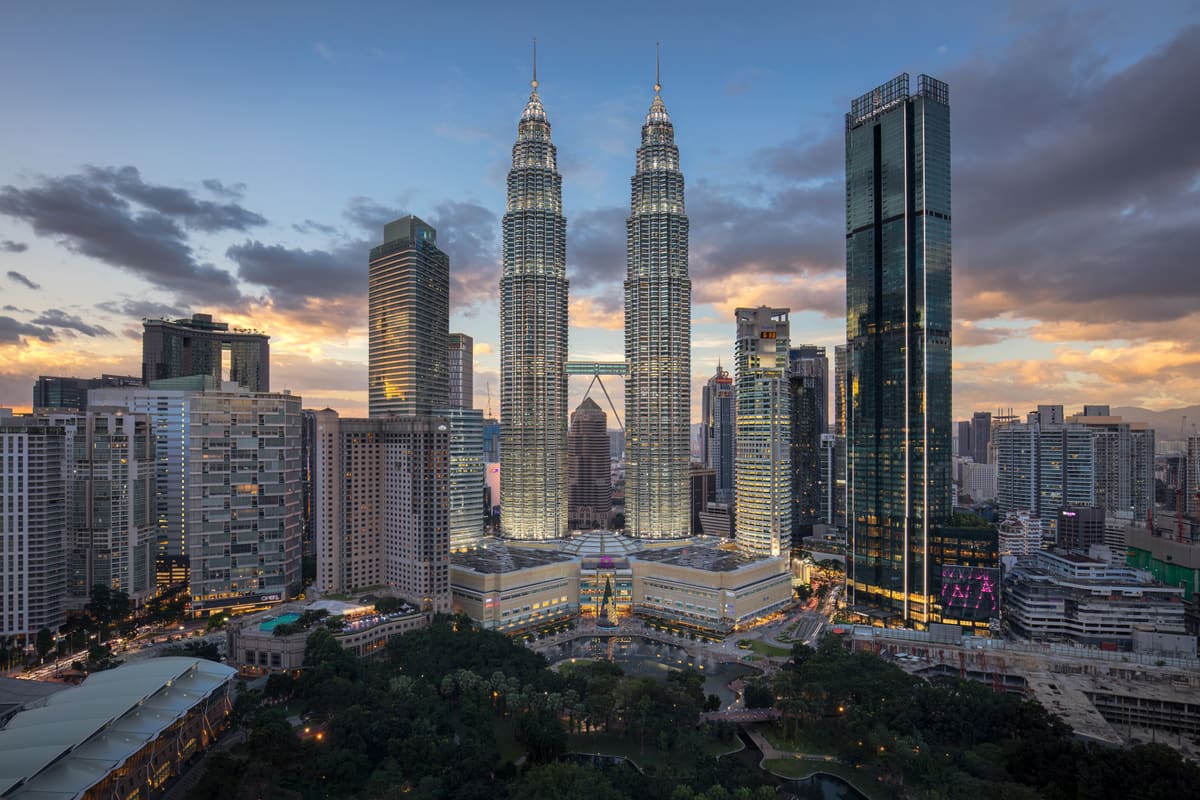
Kuala Lumpur (the "muddy confluence" — the confluence of the Klang and the Gombak rivers) is the capital of Malaysia, an 8-million-person megacity, and the most cosmopolite city in the country. The population is roughly 45% Malay, 43% Chinese, 10% Indian, plus the international expat community. The official religion is Islam, the official language is Malay, the most-spoken language is English, the most-understood language is the language of food.
The city was a tin-mining town in the 1850s, became the capital of the Federated Malay States in 1896, was occupied by the Japanese in WWII, became independent in 1957, and grew from a city of 100,000 in 1957 to 8 million in 2026. The Petronas Towers (1998) were the world's tallest from 1998 to 2004, and the city has been the most-photographed skyline in Southeast Asia since.
What to do
The Petronas Towers + KLCC (the must-see)
The 88-story twin towers, 451.9 m tall, the world's tallest from 1998 to 2004. The view from the observation deck (170 m up) is the most-photographed. The KLCC park at the base is the most-photographed public space. The Suria KLCC shopping mall underneath is the most-upscale. The Petronas Philharmonic (the orchestra) is in residence. The most visited site in Malaysia.
The Batu Caves (the Hindu temple 1 hour north)
The 400-million-year-old limestone cave complex with the Hindu temple inside. The 272 colorful steps up to the temple, the 42.7-m golden statue of Lord Murugan (the tallest in the world), the cave temple with the painted ceiling. The most-photographed Hindu site in Malaysia. Combine with a half-day trip from KL.
Merdeka Square (the colonial history)
The 100-year-old colonial center, the flagpole where the Malaysian flag was first raised in 1957 (the independence), the Sultan Abdul Samad Building (the Moorish-style government building), the Royal Selangor Club. The most-photographed colonial architecture in Malaysia.
Chinatown + Little India (the cultural mix)
The Petaling Street (Chinatown) is the street food and the night market. The Masjid India (Little India) is the textile shopping and the Indian food. The Brickfields is the Indian-Tamil neighborhood with the most beautiful Sri Maha Mariamman temple. The most-culturally-mixed in one neighborhood.
The food
KL is one of the great food cities of Asia, and the most international. The famous cuisines:
- Malay: Nasi lemak (coconut rice), rendang (dry beef curry), satay (grilled meat skewers), laksa (spicy noodle soup).
- Chinese: Char kway teow (Penang-origin, available in KL), Hokkien mee, Hainanese chicken rice, dim sum.
- Indian: Roti canai (flatbread), banana leaf rice, tandoori, biryani, the mamak stalls (the Indian-Muslim 24-hour restaurants).
- Nyonya (Peranakan): The Chinese-Malay fusion, the laksa lemak, the ayam pongteh, the most-refined of the Malaysian cuisines.
What to know
- KL is hot year-round (25-35°C, high humidity). Plan the outdoor activities for the early morning or late afternoon.
- The traffic is bad. The LRT, MRT, and monorail are the escape.
- Tap water is not for drinking. The ice in drinks is safe (factory-made).
- The food is the main reason to visit. The mamak stalls (the 24-hour Indian-Muslim restaurants) are the best way to eat late at night, the roti canai + teh tarik (the Indian-pulled tea) is the standard order.
- The malls are the main air-conditioned escape. KL has the most malls of any city in Southeast Asia, the most-photographed being the Suria KLCC, the Pavilion, the Mid Valley, the 1 Utama.
How long to stay
2-3 days for the city. 1 day for the Petronas Towers + KLCC, 1 day for the Batu Caves + the colonial history, 1 day for the food + the cultural mix. Add 1-2 days for a side trip to Malacca or the Cameron Highlands.
How to get around
The LRT, MRT, and monorail are the most efficient. The KLIA Ekspres (the airport express) is the fastest way to/from the airport (28 minutes, 55 MYR). Grab is the ride-share app. The GoKL city buses are free.
Where to stay
KLCC: The most central, the most expensive. The Petronas Towers, the Suria KLCC mall, the most upscale hotels (the Mandarin Oriental, the Four Seasons, the Traders).
Bukit Bintang: The most international, the most restaurants, the most shopping. The Pavilion, the Lot 10, the mid-range hotels.
Chinatown (Petaling Street): The most atmospheric, the most food, the cheapest. The heritage shophouses converted to boutique hotels.
KL Sentral: The most convenient for transport, the most modern. The business hotels, the chain hotels.
Cost (3 days, per person, 2 sharing, mid-range)
- Accommodation: $40-150/night × 3 = $120-450
- Food: $15-30/day = $45-90
- Activities: $20-40
- Transport: $10-20
- Total: $195-600
Filed under
Plan a trip to Indonesia
Use our AI trip planner to create a personalized itinerary in 30 seconds.
✨ Try the AI trip planner