feature
Thailand: The Land of Smiles, the Pad Thai Capital of the World, and the Kingdom That Refuses to Be Colonized
A 1,500-km S-shape that runs from the misty mountains of the north to the tropical islands of the south, with Bangkok in the middle, a cuisine that became the world's reference, and a culture that has been continuously sovereign for 700+ years — the only country in Southeast Asia that never got colo
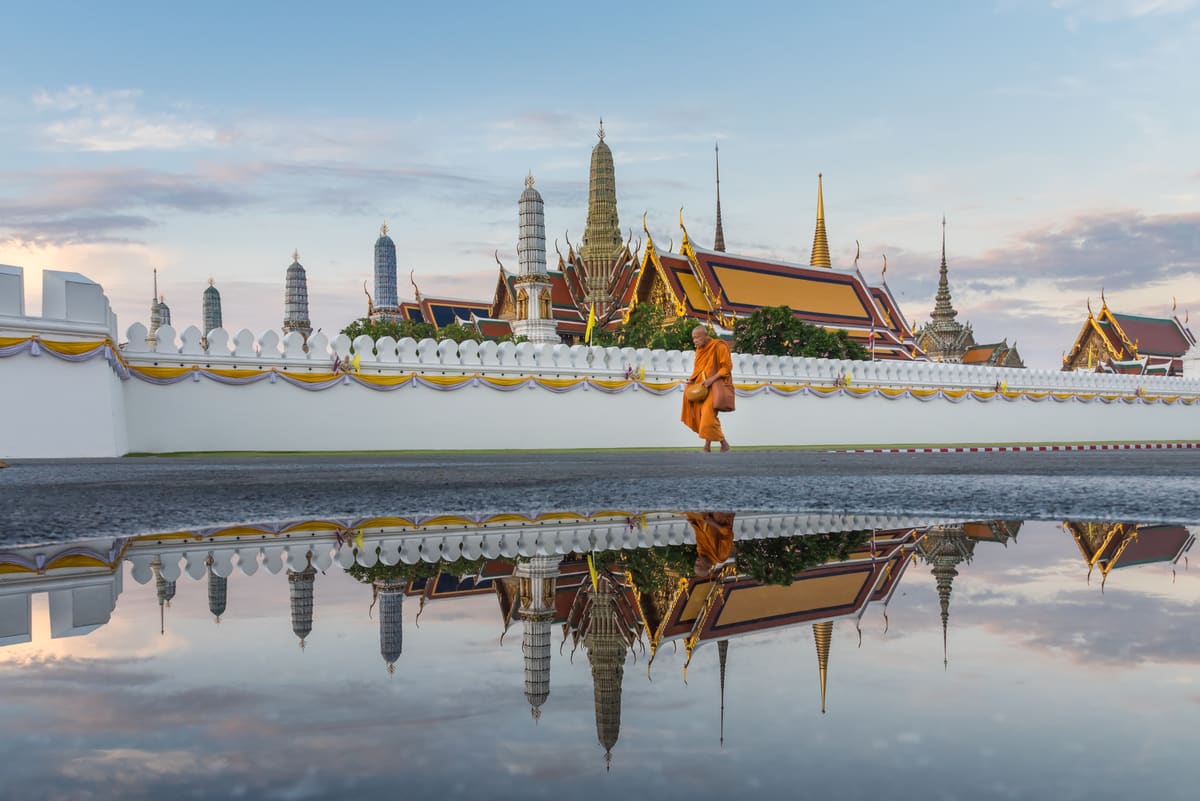
Thailand is the country that no one ever conquered. Where Vietnam was Chinese for 1,000 years, French for 100, and American for 10, Thailand (Siam until 1939) was its own kingdom for 700+ years — the Burmese came close, the French came close, the Japanese and the British were both kept at diplomatic arm's length, and the only thing that ever really "conquered" Thailand was Rama II, who made it compulsory in 1939 to call the country "Thailand" instead of "Siam."
What that 700-year sovereignty did was let Thai culture be Thai culture. The temples, the food, the language, the royal family, the Buddhist calendar — all of these have been continuously, deliberately, almost defiantly maintained. Thailand is the only country in Southeast Asia where the dominant religion is still Theravada Buddhism, the only one where the king is still genuinely revered (King Vajiralongkorn, Rama X, since 2016), the only one where the national dish is the same dish in the smallest village as in the best Bangkok restaurant.
The shape of Thailand
Thailand is roughly 1,500 km north-to-south, divided into four big regions:
The North — the mountains around Chiang Mai, the old Lanna kingdom, the hill-tribe cultures, the cool weather, the fog, the elephant sanctuaries, the rijsttafel (sticky rice) and the khao soi (the curry noodle soup). This is the most atmospheric, the most cultural, the most beautiful part of the country.
The Northeast (Isaan) — the plateau that drains into the Mekong, the most rural, the most distinctly Thai, the food capital of the country (som tam, larb, sticky rice — the dishes that Thai people themselves eat at home). Geographically in Thailand, culturally closer to Laos.
The Central Plain — Bangkok, Ayutthaya, the Chao Phraya river basin, the rice bowl of the country. The political and economic center. The flat, hot, dense, dense, dense middle of Thailand.
The South — the narrow peninsula that runs to Malaysia, the Andaman and the Gulf coasts, the islands (Phuket, Koh Samui, Koh Phangan, Koh Lanta, Koh Tao), the beaches, the diving, the most-photographed sunset in Southeast Asia.
What makes Thailand different
The food is the headline. Pad Thai is what the world knows; som tam (papaya salad), tom yum (hot-and-sour soup), green curry, massaman curry, pad see ew, mango sticky rice — these are the dishes that became a global Thai food canon. The interesting thing is that all of them are real, all of them are available everywhere in Thailand, all of them are delicious, and the best version of each is almost always the street version.
The temples are the headline #2. Wat Phra Kaew (the Temple of the Emerald Buddha, in Bangkok, attached to the Grand Palace) is the most sacred site. Wat Pho (the reclining Buddha, the birthplace of Thai massage). Wat Arun (the dawn temple, the most-photographed in Bangkok). Ayutthaya (the 14th-century capital, the ruins, the Buddha heads in the banyan trees). Sukhothai (the 13th-century capital, the original Thai kingdom). Chiang Mai's 300+ temples in a single small city.
The islands are the headline #3. The Andaman coast (Phuket, Krabi, Koh Lanta, Koh Phi Phi, Koh Lipe) and the Gulf coast (Koh Samui, Koh Phangan, Koh Tao) are the most famous beach regions in Southeast Asia. Diving in the Andaman is world-class. Full-moon party on Koh Phangan is a once-in-a-lifetime experience (or not, depending on your tolerance). Koh Tao is the cheapest place in the world to get a scuba certification.
What to know before you go
- Visas: 30-day visa exemption for 60+ countries. Easy.
- Money: Thai baht (THB). USD widely accepted. ATMs everywhere.
- Language: Thai. Tonal, five tones. The polite particle "khráp" (men) or "kâ" (women) after every sentence is the most important word to learn.
- Best months: Nov–Feb (cool, dry). Avoid Mar–May (hot, the burning season in the north). Avoid Jun–Oct (rainy season, the WET wet, the monsoon).
- Royal family: Don't speak ill of the king. The lèse-majesté law is real and enforced. Even stepping on Thai money (which has the king's image) is a social faux pas.
- Buddhism: Take off your shoes before entering a temple. Don't point your feet at a Buddha image. Don't touch a monk if you are a woman. Cover your shoulders and knees in temples.
The 2-week plan at a glance
- Days 1-3: Bangkok
- Days 4-5: Ayutthaya (day trip) or Kanchanaburi
- Days 6-9: Chiang Mai + Chiang Rai (fly north)
- Days 10-12: An island (Koh Samui, Koh Phangan, or Koh Tao)
- Days 13-14: Phuket or Krabi (or extend on the chosen island)
Thailand rewards slowing down. Bangkok is a city that takes 4-5 days to really know. Chiang Mai is a city that takes a week. The islands are made for staying 5-7 days at a time. The Thai food is so good that you should plan to eat 4-5 meals a day.
Filed under
Plan a trip to Indonesia
Use our AI trip planner to create a personalized itinerary in 30 seconds.
✨ Try the AI trip planner