Jakarta
DKI Jakarta · Java

Capital of Indonesia. Mega-city, museums, food, nightlife, the chaotic heart of the archipelago.
📸 Gallery
5 photosDid you know?
Istiqlal Mosque — largest in Southeast Asia, capacity 200,000
Cultural & historical context
<p>Jakarta has been Indonesia's capital since the Dutch colonial era, when it was known as Batavia. The Dutch built the Kota Tua (Old Town) in the 17th century, modeled on Amsterdam, with canals, warehouses, and townhouses. After independence in 1945, the city was renamed Jakarta and rapidly expanded to absorb surrounding villages and towns.</p> <p>Today Jakarta is one of the world's most diverse cities — over 300 languages are spoken, with Javanese, Betawi (the local Jakarta dialect), Sundanese, and Bahasa Indonesia as the most common. The city's ethnic mix includes Javanese (the largest group), Sundanese, Betawi (the indigenous Jakarta people), Chinese, Indian, Arab, and many smaller communities.</p> <p>The city's economic importance extends beyond Indonesia — Jakarta is a major financial center for Southeast Asia, with the Indonesian Stock Exchange and headquarters of major banks and corporations. The metropolitan area generates over 20% of Indonesia's GDP.</p> <p>Modern challenges include severe traffic congestion (the city is consistently ranked among the world's worst for traffic), air pollution, flooding (the 2007 floods covered 70% of the city), and the slow-moving capital relocation to Nusantara.</p>
Key facts
- ◆Metro population 34 million — 2nd largest metro area in the world
- ◆Capital of Indonesia since 1945 (after Dutch Batavia)
- ◆Founded as Sunda Kelapa in the 5th century, renamed Jayakarta in 1527
- ◆Istiqlal Mosque — largest in Southeast Asia, capacity 200,000
- ◆Sinking 25 cm/year due to groundwater extraction
- ◆Over 300 languages spoken in the metro area
Best for
Good to know
- ✓Use Gojek or Grab for reliable transportation — both work well
- ✓Traffic is genuinely terrible — build extra time into any schedule
- ✓Tap water is not safe — stick to bottled or filtered water
- ✓Air quality can be poor, especially in dry season — N95 masks recommended
- ✓Dress modestly when visiting mosques and Islamic sites
- ✓Carry small change for street vendors and parking attendants
- ✓Indonesian is the lingua franca; English is widely spoken in tourist areas
Getting there
<p><strong>Soekarno-Hatta International Airport (CGK)</strong> is 20 km west of the city center, with two terminals connected by the Skytrain. The airport has direct flights from every major Asian city, plus Australia, Europe, and the Middle East.</p> <p>From the airport, the <strong>Railink</strong> train connects to BNI City station in central Jakarta in 45 minutes (Rp 80,000).</p> <p><strong>Halim Perdanakusuma Airport (HLP)</strong> is closer to the city center and handles domestic flights plus some regional services.</p> <p>Public transit includes the <strong>MRT</strong> (north-south), <strong>LRT</strong> (serving Greater Jakarta), <strong>KRL Commuterline</strong>, and the <strong>TransJakarta BRT</strong> (the world's longest BRT system with 13 corridors).</p> <p>Avoid driving or sitting in taxis during rush hour (7-10 AM and 5-8 PM). Jakarta's traffic is legendary.</p>
What to do at Jakarta
16 things to do
Top-rated attractions, activities, and landmarks

Cooking Class of Jakarta
Half-day market-to-table experience — buy ingredients, cook 4-5 local dishes, eat what you made.

Street Food Night Market of Jakarta
Open-air food court — 50+ stalls, plastic stools, local beers, and the city's best cheap eats.

Grand Temple of Jakarta
The main religious complex — central spire, surrounding cloisters, and active worship daily.
Local Coffee Shop of Jakarta
Single-origin beans, traditional brew method, and pastries — a local chain.

Waterfall in Jakarta
Notable waterfall in Jakarta. Cultural and natural heritage.

Cultural Show & Dinner of Jakarta
Traditional dance performance with regional buffet — a two-hour evening experience.

Heritage Walking Tour of Jakarta
2-hour guided walk through the historic center — architecture, food stops, and stories.

Botanical Garden of Jakarta
Tropical gardens — orchids, lotus ponds, walking paths, and shaded benches.

Riverside Promenade of Jakarta
Walk along the river as the sun sets — food carts, local families, and the city skyline.

Royal Palace of Jakarta
If still standing or reconstructed, the old royal complex — throne room, gardens, and ceremonial halls.

Sunset Cruise of Jakarta
Evening boat ride along the coast or river — cocktails, dinner, and the city lit up.

Art Gallery Quarter of Jakarta
A few streets of contemporary galleries, cafés, and design shops — the city's creative heart.

Old Town of Jakarta
The historic heart of Jakarta — colonial architecture, narrow lanes, and centuries of street life.
Skyline Observation Deck of Jakarta
Panoramic view from the city's tallest building — best at sunset and after dark.
National Museum of Jakarta
The country's flagship museum — archaeology, ethnography, and decorative arts from the region.

Central Market of Jakarta
The city's main bazaar — produce, spices, household goods, and the best breakfast stalls.
Country snapshot
🏝️ Indonesia is the world's largest archipelago with 17,000+ islands.
Other places in DKI Jakarta
See DKI Jakarta guide →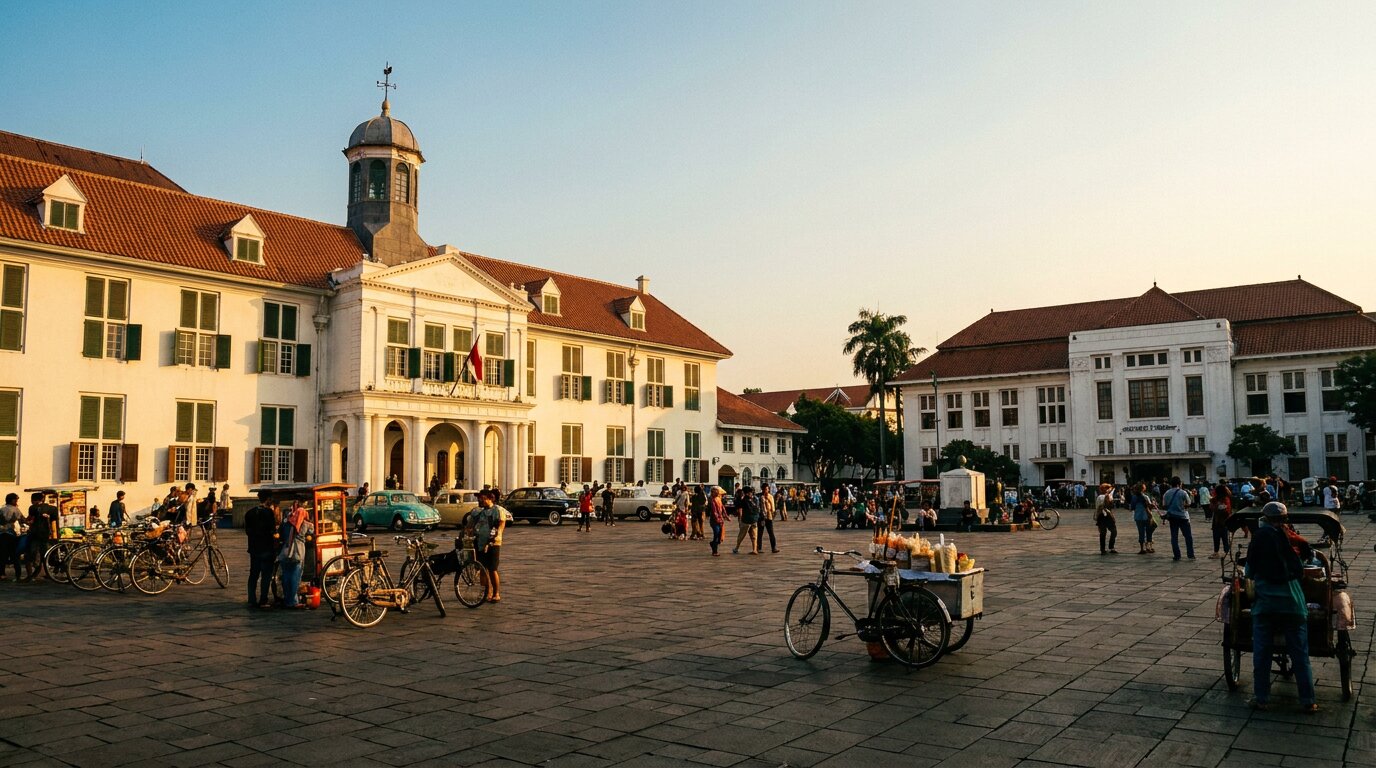
More in Java

Taste of Java


Parks & nature nearby

Nearby places
Finding places nearby…